Cyan Starlight early thoughts
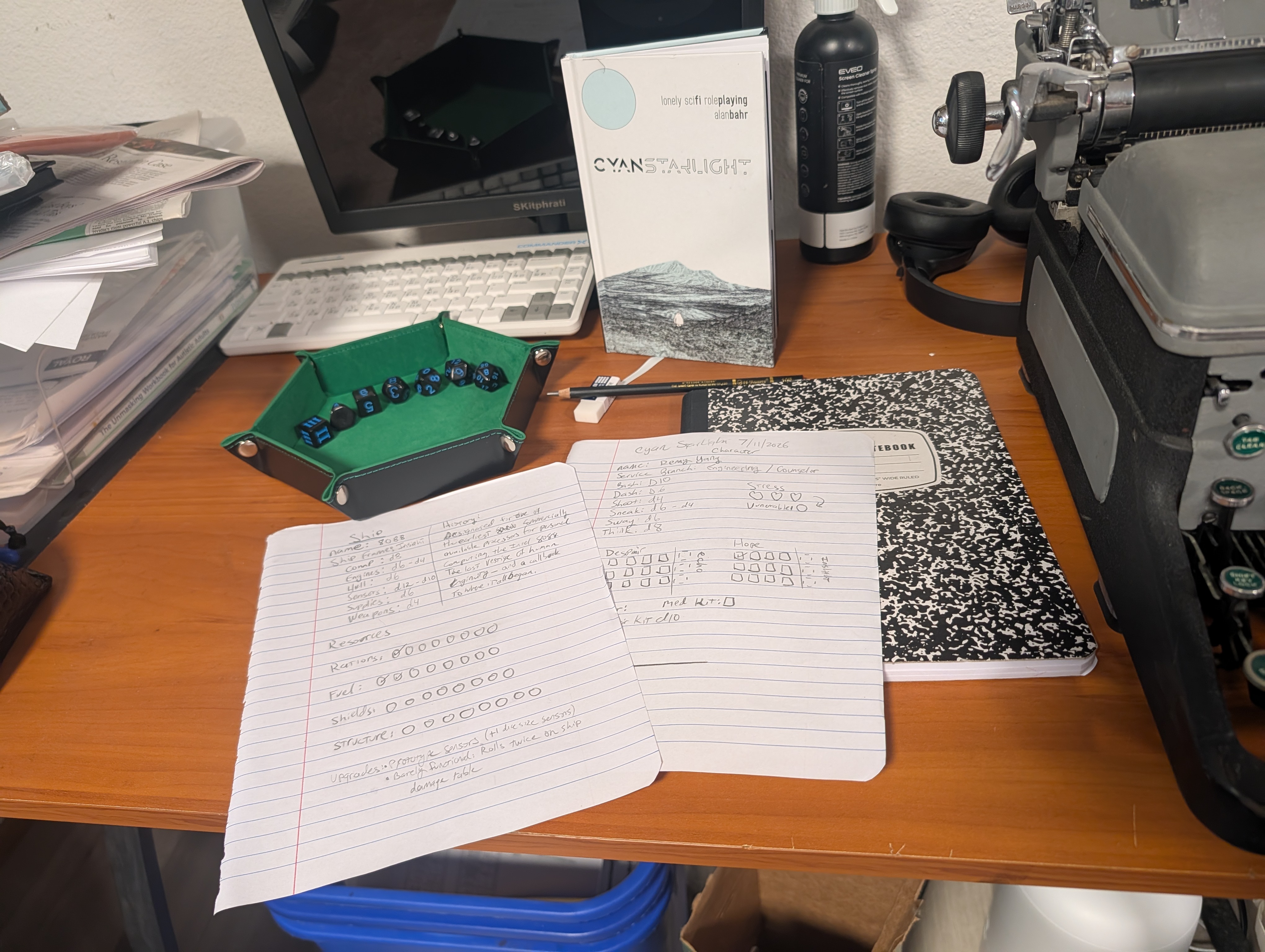
I recently picked up a new hobby, by virtue of trying to find stuff I can do while I spend far more time at my mom's house than usual. (The long and short, for the time being she needs more care than usual, and I'm the primary caregiver, so I haven't been around the house much for a bit.) I don't really want to spend all day on my phone, and although I enjoy reading time, it's also useful to have something more cognitively engaging during downtime there, with limited space, and almost no other resources at my disposal.
Enter solo TTRPGs. More familiar TTRPGs include games like Dungeons and Dragons or Shadowrun, which I've played at one point or another but never really had enough of a group together to maintain as a group hobby. (If you happen to be near-ish to the Seattle area and inclined, feel free to contact me, I'd love to hear from you. I have dice!) The solo variety substitutes most of the Gamemaster/Dungeonmaster roles for dice and your own creative energy.
The first of these I've played and been somewhat deeply engaged in recently is Cyan Starlight, which can (as I have) be played without any computers in sight and with limited desk space, although the website offers a decent selection of useful tools (which I can't comment on as I've played it with just the book, dice, and paper.)
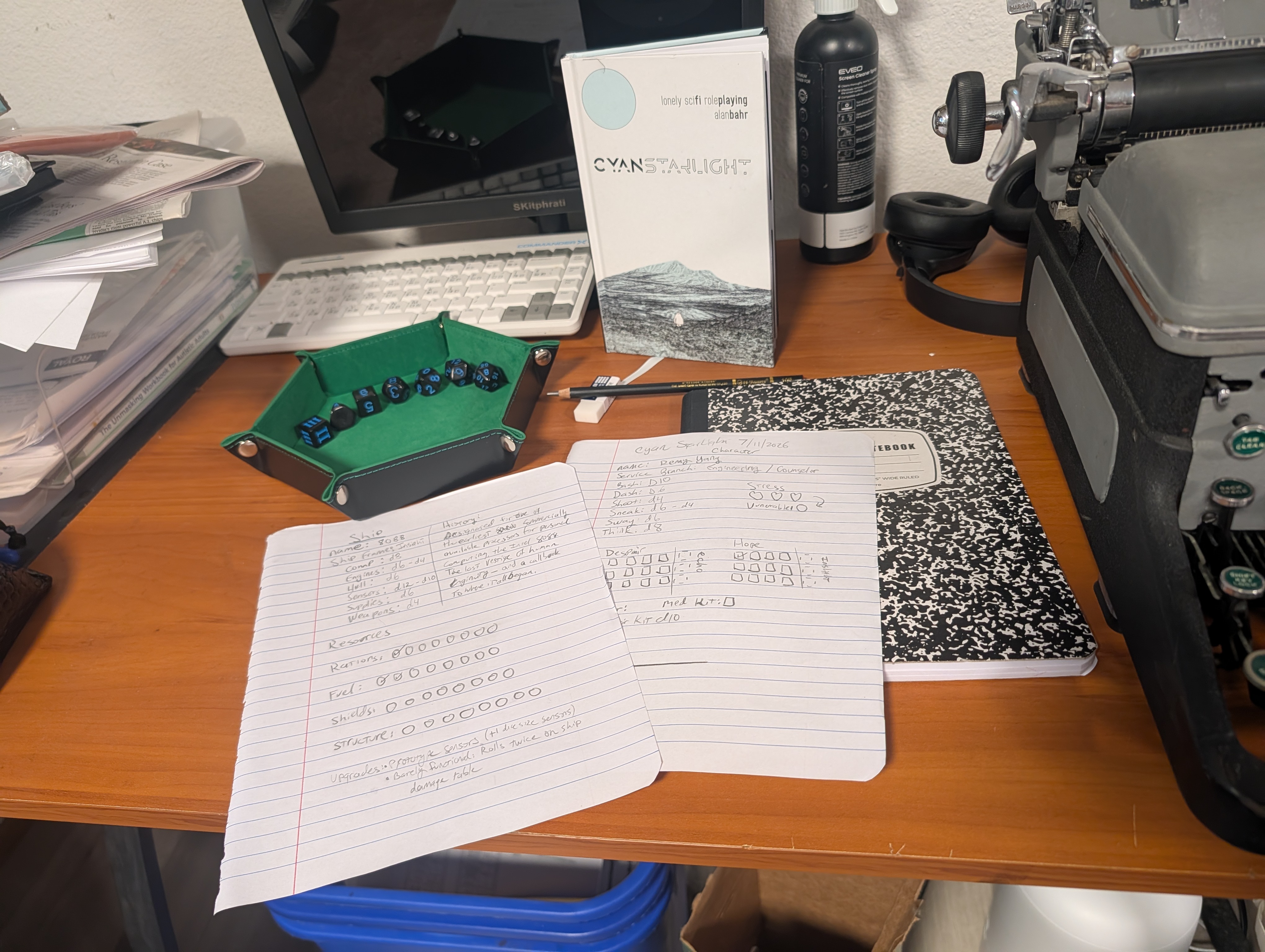
I'm still a novice player - but since I've spent more than a handful of hours reading through the rulebook and studying it as I try my hand at playing the game, it seems like it could be useful (or a fun reference for my future self) to document some of my early thoughts about the game and the struggles (or successes) I had in getting into it.
It's more freeform than I expected.
The one-sentence introduction to the game itself is that you're apparently the last human, you awake to a galaxy whose background has changed into a cyan haze, and otherwise only aliens, with no knowledge of exactly how humanity ended (or if there may actually be others out there somewhere). Your task is to explore the galaxy to understand what caused the cyan haze, what happened to humans, and whether these are related, assuming you can survive long enough to do it. I'll leave the topical introduction to the book or website, rather than reiterating it, but that's enough to follow along.
Admittedly, I seem to have had some preconceptions going in. I've played single-player RPGs in the form of dungeon crawlers, roguelikes, and other computer-assisted approaches, where the lack of a dungeonmaster is compensated for by a large and convoluted set of rules which automate the rest of the world within some stochastic boundaries. That is, if you're playing Nethack, then you expect the orcs (represented abstractly by "o") to move around, usually in the general direction of your character (an "@") should you be visible and so forth.
I've also played (albeit a handful of times) and listened to (many, many more times) people playing group TTRPGs like D&D. And there, the typical case is that almost everything you do requires a roll, the game (or game master) sets the target and you meet it or don't, but everything ultimately has some externally imposed success metric from the perspective of the player, which is usually defined in a great level of detail leaving relatively little ambiguity about what to do with what you're trying to roleplay.
I expected this approach, of a detailed set of rules that would lay out all of the options at your disposal, the dice you needed to roll to succeed or fail, and the mechanics of what NPCs would do. Cyan Starlight simply isn't like that, it's far more freeform. There is a general flow where you roll dice against some lookup tables to find out the danger levels and decide what resource costs are imposed, and then whether and when an enemy might attack you. But it doesn't tell you much about what the enemy actually does, beyond a paragraph or so of narrative explanation of what they are, and a handful of special actions they could take.
My first stumbling block was actually just understanding what the term "standard attack" meant! This is one of the options when you initially encounter an alien - the specials have clear mechanics, but aside from throwing the word "standard attack" out as a dice result, there's no explanation.
I watched (or, rather, listened to, during commutes to Swedish Hospital) the entirety of Adept Icarus' Preview Playthrough on YouTube, which was informative, but in that entire run they never actually had an enemy standard attack, leaving this question still open-ended.
My conclusion of having listened to its playstyle from the creator themselves led me to the conclusion that it was open-ended, you just decide what you think should happen, roll on the Yes/No Oracle or roll some player attribute or item to respond, and go for it. This is so wildly open-ended that it's almost like a mildly guided storytelling exercise, lacking the majority of scaffolding that my previous experiences prepared me for.
You need sticky notes.
I found that the game's book has (most - see above for the open-ended side of it) of the information you need to play, but it is not organized well as a reference manual. This is clearly organized in the way the creator's mind saw it, which isn't a bad thing, but it reminds me of reading fan fiction. All of the characters are there, and they're doing things that make sense to a particular fan, but they aren't necessarily happening in an order that could be transformed into a screenplay, or critiqued as a piece of literature, it just exists as the output of someone's imagination frozen in writing.
This actually made the rules quite readable when I read it the first time through, cover to cover. Getting the idea of what sorts of things are available to you is pleasant. Actually sequencing these - doing the actions you need to do in the order you need to do them, looking up the details you don't have in your head right this moment, that task is much less easy.
I didn't have anything but my own mind and a notebook, so in particular, I found myself learning this game without using sticky notes - which are otherwise a ubiquitous tool I use when studying. On the flip side, the book is short, and the rules occupy only a small fraction of the book (with the rest being a bestiary and inventory and a reference of tables).
Ultimately it's simple enough that I eventually memorized some page numbers - I know, without even looking as I write this, that the mechanics of Risk and Checks are documented on page 26, because I still haven't internalized those rules yet, but I need them so often that the page is practically seared into my retinas.
Now that I've been home long enough to write this blog post, I also took a moment to pack some sticky notes in my bag. If I had to give any one piece of advice to anyone else picking this up, it's get some sticky notes for labeling pages, and dedicate a couple of pages in your journal to creating your own glossary and index. It would have made it so much easier to get started.
You're in the driver's seat.
I suppose this is a natural consequence of being as open-ended as it is, but this game doesn't really have any mechanics that force the game to move forward. If all you do is follow the steps and go, you're very unlikely to actually make something that seems like progress - you might check off resource boxes and roll dice, but they're completely meaningless without the narrative scaffolding, which you also need to sort out what happens next.
This is a story you tell, not a story you merely experience. If you aren't telling a story, there's not much else there.
I plan on playing a few more campaigns after this one, but the one I've played to learn the game with definitely started that way, and it wasn't clear until I started just playing that there was even momentum.
I think if you think of each location the way a Monster of the Week episode of Star Trek or X-Files goes, it works pretty well. The overall narrative is light, what happens is very light and open ended, but what exists at the location is much more thoroughly set by the dice. You'll know if it's a Nevacrean Zealot or a swarm of Bugs; you'll know if the planet is hazardous or a playground. You put the detail in, but the scaffold is there to work with -- not entirely unlike the scaffolding that happens in the first handful of sentences after Captain Picard utters the words "Captain's log, stardate 1275347.5".
Finial Initial Thoughts
Given how many preconceptions I didn't realize I had, and how much different this game is than what I expected as a result, I think this has sort of broken my mental picture of what a single-player RPG is, and is like. Not in a bad way by any means, of course, I'm content saying that I am rather enjoying this so far. I have some background projects (a certain friend of mine will know, should they see this) where acquiring some more fluent writing skills would be beneficial, and this seems to be helping draw that out of me after I let my guard down a bit.
On the other hand, I am quite certain I will never publish the contents of a playthrough. It's too silly, it's too unstructured, it's lacking the interplay that playthroughts of TTRPGs with other people have. Adept Icarus' own playthrough that I linked earlier is three people contributing, even though it's a solo RPG, and they mentioned similarly that it wouldn't make for compelling watching.
But actually it's a little deeper than that. This game is something the author's foreward describes as being deeply personal; it approaches loneliness and mental health topics forwardly.