Be Comfortable with Solutide
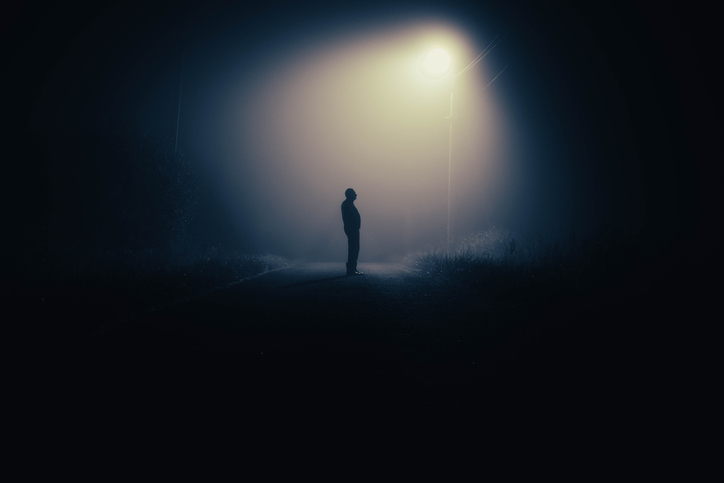
I mentioned my Cyan Starlight gameplay to someone the other day, in a passing conversation, it probably wouldn't even register. Their response was, in a nutshell, that they were surprised by the concept of playing a single-player ttrpg. That interaction made me think I wanted to write up something about solitude, especially as the world as it exists and my own personality traits combine to having a large fraction of my time spent alone. I do not consider that unhealthy, which also seems to surprise people when I talk about it, and the only word most people have to relate to this is "introvert". But that isn't it, either, although I do think that being introverted is one of the personality traits that led me to this mode of living.
In fact, Cyan Starlight has not been an entirely solo endeavor. I've reached out to the community on Discord and vicariously lived the solitary adventure with others already -- and in any case, when this playthrough is done, the journal is an artifact that will certainly make its way into my friends' hands, it will become a topic of discussion among that group of people who haven't played it. But I could not have those discussions without the solitary effort. The journal wouldn't exist. The information and experience of having played the game wouldn't exist. There wouldn't be anything to talk about.
Reading a novel is very similar in this regard. Reading a book is a solitary activity (aside from reading aloud or the like, but by and large) - you sit down, even if there are other people physically nearby, and remain totally focused on the pages, the text gradually rewiring your neurons to incorporate the information contained within. And you come away with that. You go to a book club, or you talk about it with friends, or sometimes you sit with it and just learn from the experience. If it's a textbook or the like, you use it in practical applications. Those are all social results of that wholly solitary activity.
Today, we live in a highly, intricately, and immediately connected world. Social media exposes us to every happening of everyone around us that they might fleetingly wish to share (editorialized only in the immediate act of what is shared; nobody curates their historical social media posts on any sort of regular basis.) But it's not inherently a social activity. If you want to socialize with social media, you need to put active effort into leaving comments, responding to comments, and doing so with the same rigor you would any friendship sans social media. The net result is a highly distracted, chaotic environment where it is difficult to focus, and people who need to focus take social media detoxes. (Myself included, for that and other reasons, and for an extended time!) This simulacrum of fellowship feeds an illusion that you are not solitary, and the negative mental health effects of social media seem to mostly relate to people who thereby lose their tolerance for solitude.
In my own life, that is why I spend a great percentage of my time alone. I'm not avoiding social activity - I'm spending the time feeding my mind, bringing thoughts and ideas to their natural maturity, honing the skills and experience that I then rely on when I am with other people. And in the end, my time spent around other people is deeper and more meaningful because of it.
Be comfortable with solitude -- it's a superpower in this modern, connected world. Take time to spend by yourself deliebrately. Do it mindfully: use the time to feed your mind; learn to tolerate being alone so thoroughly that it becomes your default. And then, when you are around other people, you may - as I did - just find that you're all the better for it.
Stoics and Solitude
I would be lying if Stoicism didn't play some part in my preference for solitude. You can't do the mental work of a Stoic if you never have downtime, and you can't detach and radically accept reality as it exists if you maintain longing for company (anymore than you could if you rejected the company of others entirely). This blog post isn't about Stoicism, but as a philosophy that does influence me, I do still want to share a few resources for anyone (possibly including myself, should I come back to this later) who wants to learn more.
- https://modernstoicism.com/some-stoic-musings-on-loneliness-by-kevin-vost/
- I am particularly often recalling this quote from Marcus Aurelius, via the article:
Today I will encounter some lonely person, the bereaved perhaps, the newcomer to this city or to this school or place of work, the person who feels left out even within his or her own family, and this person may ignore me, not look me in the eye, not return my greeting, or treat me with suspicion, but I will remember that such people are my brothers and sisters and God has called us to be there for one another. Therefore, I will still make some effort to connect with them even in the smallest of ways to lighten the burden of their loneliness.
- I am particularly often recalling this quote from Marcus Aurelius, via the article:
- https://www.youtube.com/watch?v=Q2rfbk-vXVg Ryan Holiday's broader overview in video essay form may be a quicker introduction for some folks.
Please don't be lonely.
While I'm encouraging people to learn to enjoy being alone, this is to encourage solitude, not to encourage loneliness. If you are finding that you need social interactions, please seek them out. Loneliness is a huge risk factor for mental health, and if being alone inspires loneliness in you rather than solitude, then it is probably not the right time to explore it.
I'm not a psychologist. I'm just a human saying things that make sense to me. Be kind to yourself, and do the same.